
Wild Wellbeing: Hug a Tree... With Your Eyeballs!
Sarahlynn Etta | AUG 19, 2024
Wild Wellbeing: Hug a Tree... With Your Eyeballs!
Sarahlynn Etta | AUG 19, 2024
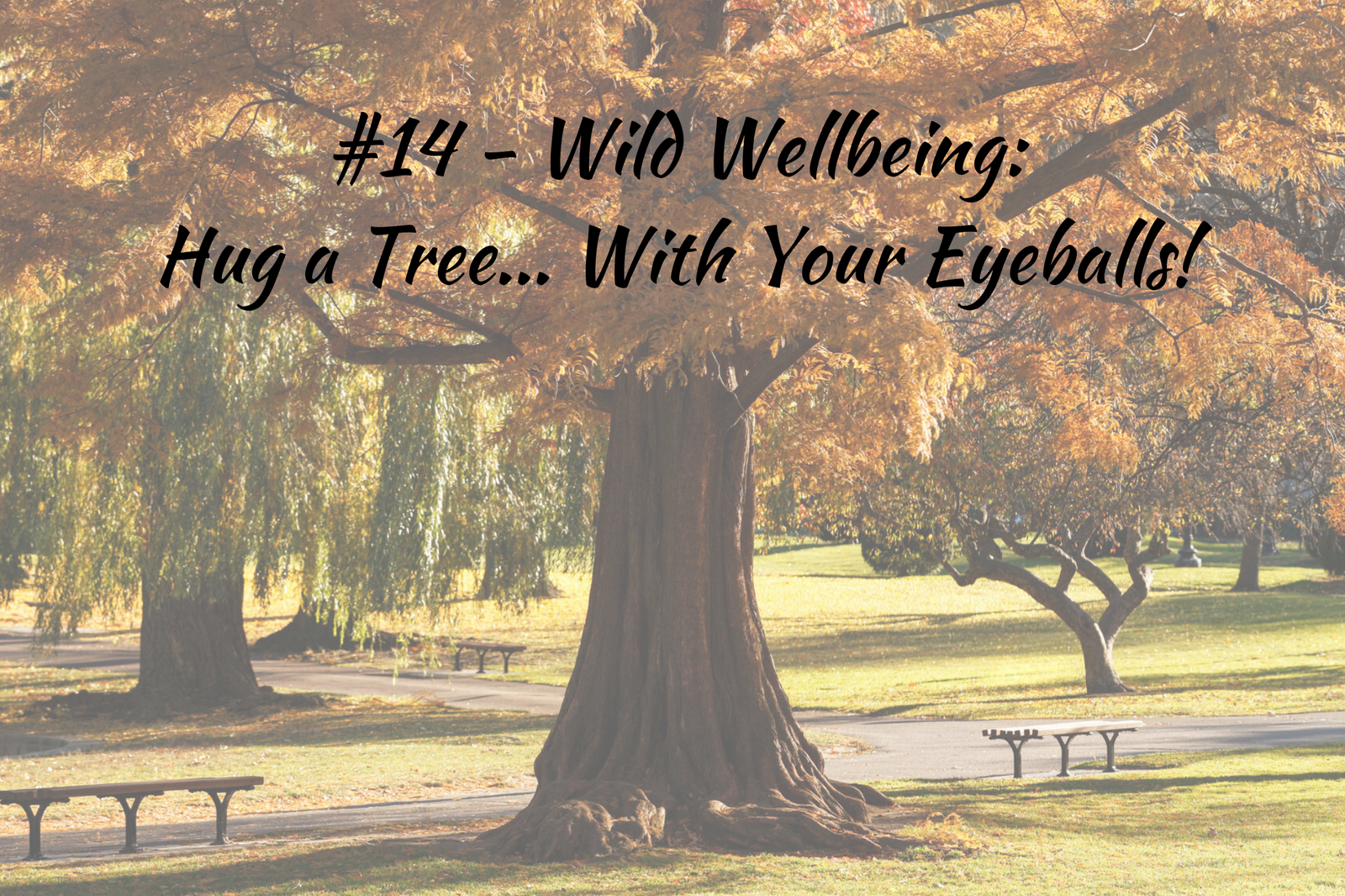
Mindfulness x nature therapy = bonus benefits for whole-being wellness! What are the benefits are practicing mindfulness in nature? Why is mindfulness outdoors more accessible for some people? Making the practice work for you. Plus, practice a partially guided mindfulness meditation outside!
Listen on Substack | Listen on Spotify | Listen on Apple
In this episode, I discuss:
Episode transcript:
"...I want to continue musing today on the wonderful, magical, healing potential of nature. I really want to bring together mindfulness meditation and meditating in nature. I'll touch briefly on the benefits and some different options for how you could go about this, and then ways I would really like you to kind of take it and make it your own and make it work for you.
In thinking about the benefits, doing a mindfulness meditation in a natural environment, we're going to get all the benefits of mindfulness and all the benefits of nature. Thinking back on all the myriad things we have discussed, all the benefits to our cognitive, mental, emotional health, to our social connection, to our self-awareness, our creativity, the benefits to our cardiovascular health, our respiratory health, immune function, healing time, and recovery. And I'm sure there are many others that I am forgetting to name in the moment.
And then for certain people, for certain types of nervous systems or learning styles, brains, there's this added benefit of doing meditation in nature may be more accessible, may be easier to stick with it, to enjoy it. And then additionally, for those folks for whom focusing on, say, a breath sensation causes a sense of discomfort or focusing on other body sensations, tissue sensations causes some anxiety. We can keep this idea of focusing on something that's happening in the present moment, but take that away from anything happening in our body.
And again, depending on your personal makeup history brain, that could make this a much more enjoyable, accessible practice for you, which then of course is going to give you access to all of those benefits.
So, as an example, someone like myself, who can have a difficult time sitting still and focusing on sensations in my body, in an environment that feels, that feels artificial or restrictive, if I take myself outside into the fresh air, maybe there's a little bit of a breeze, maybe there's some nature sounds in the background, something about that helps me stay more grounded and focused to the present moment. And then focusing on something like a tree, instead of myself, is also going to create more ease.
So today, I am actually going to present a mindfulness meditation focused on taking in the experience of a tree. And what I would offer to you, or what I would invite you to continue to experiment with, is first, it does not have to be a tree. And second, eventually, hopefully, you're getting to the point where you've left the phone at home, you've left me at home, you've left the earbuds at home, and you are doing this process on your own.
For this partially guided mindfulness meditation that I will share today, I will be focusing on a tree. So just know that you could listen to it one time, or you could even listen to just enough of it to get the idea, and then you could take that out to your favorite beach, and you could apply the same sort of idea to watching the waves. You could observe a field of wildflowers. You could observe a mountainscape in the distance.
So as we're thinking about all the different types of meditation, whether we're sitting still or whether we're moving, whether we're focused on our own body, our own breath or something else, even thinking about something just as subtle, as nuanced as will it be easier for me to stay engaged with a field of wildflowers or with the surface of a lake?
And again, experiment.
You might have to try a few different things before you find one that feels like it works.
And then whatever that is, start bringing that into a more regular practice for yourself.
As always, it doesn't have to be every day, and it doesn't have to be super long.
You don't have to start the tree for an hour.
But could you take maybe a few minutes, a few times per week, to take this moment of quiet reflection, observing that object of focus you have chosen, and letting everything else go?
And with mindfulness, of course, we know that letting everything else go, peace, is, it is a practice.
So most of us, probably not for a very, very long time, or maybe even not in this lifetime, we're never going to just have a mind that is empty of other thoughts.
But it is the practice of noticing when those thoughts have gone elsewhere, noticing when those distractions have arisen, and gently bringing yourself back to the experience of the tree or the lake or the flowers in that moment.
And on that note, let's do a mindfulness meditation in nature together.
So, again, I'm going to go through this whole process using a tree as your point of focus.
If it works for you, please go outside, find a tree, listen to the whole thing from start to finish.
If you'd rather listen to some of it to get an idea, then go out and do your tree without your phone, without me, without your earbuds, or make it something else.
So as you think about how to set yourself up this time, I know that I very, very often offer the option to walk slowly through a familiar area.
For this particular meditation, you will be focused on the same visual object throughout.
So I would encourage you to choose a really, really comfortable seat, or if you have a place outdoors where you could lie down comfortably, and then maybe you're focused either on the sky or on the tops of the trees.
For today, for this together, I'm going to move as though you are seated in a place, comfortably, of course, where you can take in the entirety of one tree.
So as you start to bring yourself into this easy seat, maybe you're on the ground, perhaps you're on a cushion, or maybe you are in a comfy chair or on a bench.
Take a moment first to check in with the sensations in your physical body.
Notice what you could adjust to find a little more comfort, a little more ease.
As you soften and surrender into the support of this seat, notice the feeling of an in-breath and the feeling of an out-breath.
And then begin to gently, slowly scan your surroundings, visually taking in all the colors, textures, shapes, all around you.
And then bring your gaze to the bottom of a tree that is nearby.
Bring your awareness to the place where the tree connects to the earth.
And for a moment, keep your awareness fully anchored to this point of connection.
Notice any parts of the trunk, bark, roots that are connected to the earth, connected to the soil.
Are there rocks, moss, or other things present where this tree rises from the earth?
As you continue to scan, to take in, to notice all the information, all the detail, the texture, the color of where this tree connects to the earth, gently notice when your mind wanders.
And with compassion, come back to notice the base of the tree.
Notice with gentle compassion if the mind wandered.
And if it did, that's okay.
Come back to the moment.
Back to the tree.
Allow your gaze to begin to travel up the trunk of the tree.
Notice all the variations in the color and the texture of the bark of this tree.
Allowing yourself to focus in on smaller pieces of the trunk, and then maybe the entirety of the trunk.
And for a moment, allow your gaze to continue to stay here, taking in the trunk of this beautiful tree, noticing when there is discomfort or distraction, and bringing yourself back with kindness.
Notice your mind, notice your thoughts.
Bring yourself back to the moment.
Allow your gaze to travel further up the tree.
Come into the place where the branches begin to spread out from the trunk of the tree.
Notice the many different sizes, shapes, angles, and angles.
Notice in this space where this trunk branches out into all these different pieces.
And for a moment, keep your gaze anchored here, continuing to notice these points of connection.
Notice the branches, notice the bark, notice the textures, the colors.
And when distractions arise, with kind compassion, bring your thoughts back, back to the tree in this moment.
And with gentleness, notice.
Are you still with the tree?
Has the mind wandered?
Coming back to the experience of the tree in this moment, allow your gaze to spread up and out to where the branches begin to sprout needles or leaves.
Notice the change in color and texture where trunk turn to branch, turn to twig, and now needles or leaves, the depth, the layers, the richness.
And for a moment, allow your mind to rest here, taking in the experience of the needles or leaves of this tree.
Each time the mind wanders, coming back.
Notice your mind, notice your thoughts.
Let your awareness broaden out to take in the entirety of this tree, its foundation, its trunk, its branches, its needles or leaves.
See if you could for a moment cultivate a sense of appreciation for this beautiful tree, for how it has allowed you to practice.
If you would like, say, thank you, tree.
Notice again the feeling of your own breath, the feeling of your body connected to your seat or to the earth.
Allow your gaze to move past the tree.
Scan your surroundings.
Reorient yourself to the space.
Perhaps take a moment to reflect, to notice how you are feeling in this moment.
As always, please feel free to reach out.
Let me know how this practice went for you, and I will see you next time..."
Sarahlynn Etta | AUG 19, 2024
Share this blog post
 OfferingTree